A Plan That's Fully Yours.
A free email course for women whose finances are changing: after a divorce, after a loss, or when money a partner always handled becomes yours to manage.

Start the Course.
Use the email address where you get The Waco Buzz. Your welcome email from Jessica arrives in about 5 minutes.
Starting a course also subscribes you to The Waco Buzz, Waco's free local newsletter, if you aren't already. Unsubscribe anytime.

Last email's big point
- Taking your seat means knowing what you have alongside your spouse, and a monthly money date keeps you both current.
Today's key takeaways
- A plan starts with one page listing every account, whose name it's in, and who it goes to.
- Old accounts from past jobs are the easiest ones to lose track of.
- Write down where to log in, never the passwords themselves.
Hi there,
We're best known for co-designing one-page financial plans to help busy people make clear decisions. Every one of those plans starts with a single sheet of paper listing everything you have.
Lisa and Mark built theirs at the kitchen table over two money dates. Mark pulled up each account while Lisa wrote.
Lisa and Mark put $671,000 on one page
| Account | Whose name | About | Goes to |
|---|---|---|---|
| Checking and savings | Joint | $31,000 | The surviving spouse, if the account has survivorship rights |
| Mark's current 401(k) | Mark | $430,000 | Lisa; no backup named |
| Mark's rollover IRA from his old job | Mark | $88,000 | Lisa; no backup named |
| Brokerage account | Mark | $64,000 | No beneficiary; passes under Mark's will |
| Lisa's IRA | Lisa | $36,000 | Mark |
| Lisa's 401(k) at the dental office | Lisa | $22,000 | Mark |
| House in Woodway | Joint | $360,000, with $84,000 left on the mortgage | |
| Life insurance through Mark's work | Mark | $210,000 | Lisa |
The page turned up a forgotten IRA and blank beneficiary lines
- An account she didn't know about. The rollover IRA from Mark's old job holds $88,000. He rolled his old workplace retirement account into it in 2011 and hadn't looked at it since. Accounts from past jobs are the easiest ones to lose track of, for either spouse.
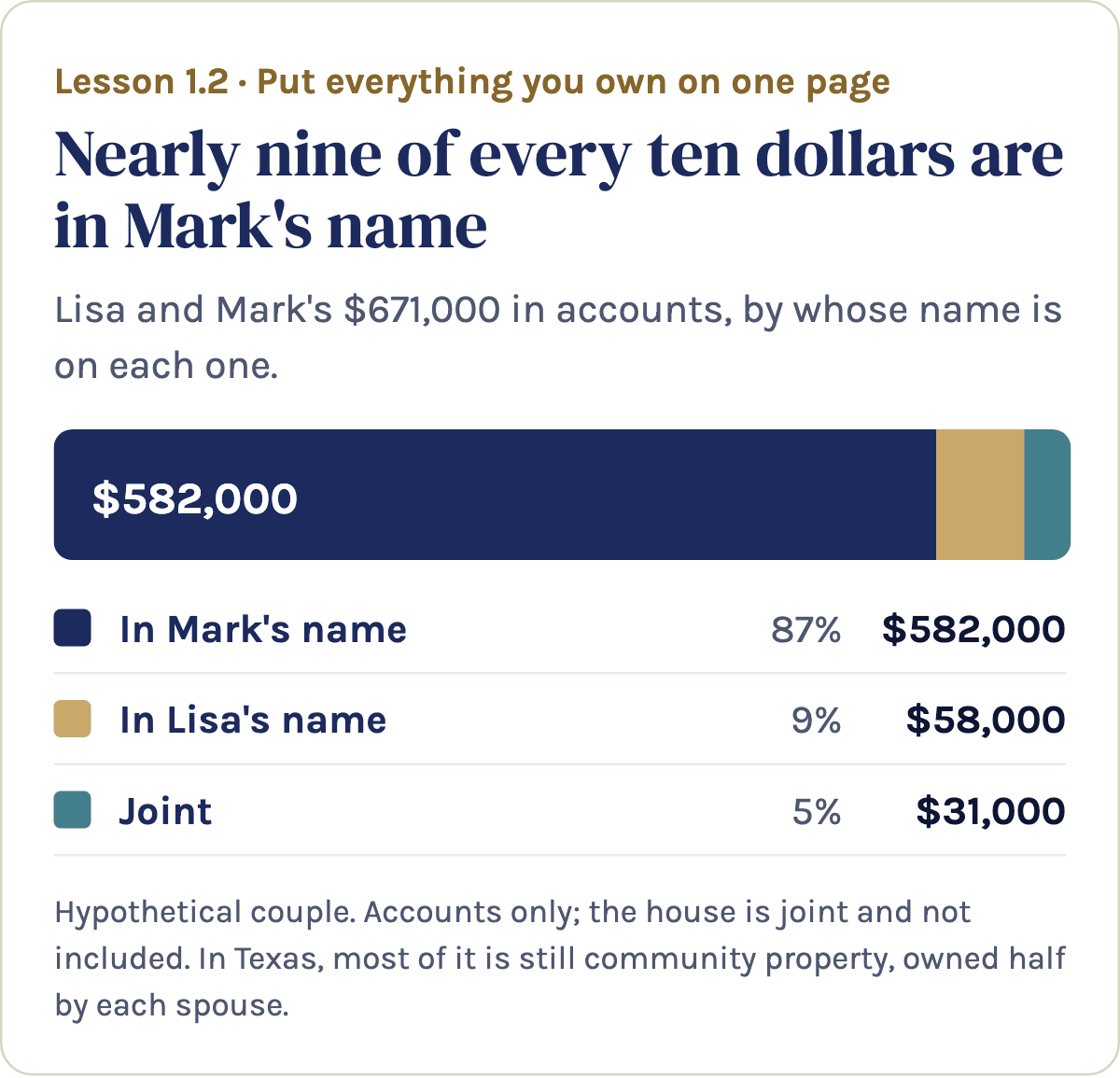
- Where the money sits. Of the $671,000 in their accounts, $582,000 is in Mark's name alone. That's common when one spouse earned most of the paychecks, and it raises the question in the next email: who could act on those accounts if Mark couldn't?
- Blank lines. Neither of Mark's retirement accounts names a backup beneficiary, and the brokerage account names no beneficiary at all.
Write down where, never the password
Next to each account, Lisa wrote the company, the phone number, and the login name, but not the password. The page lives in their fireproof box, and both of their grown kids know where to find it.
In our office we call this page an Asset Map. We build it from about 10 or 12 simple questions, like whether you have a retirement account or a mortgage, that you can answer without your statements in front of you.
A question worth sitting with: Is there an account from a past job, yours or your spouse's, that you haven't looked at in years?
In the next email: whose name is on each account, who it goes to, and who could act on it if you or your spouse couldn't.
Jessica
A full lesson from the course. Scroll to read it.