Practice on Your Terms.
A free retirement email course for Texas physicians. Learn how working part-time before you retire changes what you'll have at 70, how to choose the way your 457(b) pays you, how to turn savings into a paycheck with no pension, and how to keep taxes and Medicare surcharges down.

Start the Course.
Your welcome email from Chad arrives in about 5 minutes.
Starting a course adds you to Winnacle Wealth's email list. Unsubscribe anytime.
Last email's big point
- Savings pay everything Social Security doesn't. You can buy a set payment for life, take a steady amount each year, or take more in good market years and less in bad ones.
Today's key takeaways
- Before you leave your job, you choose when a nonprofit's 457(b) starts paying you, and whether it pays in one lump sum or in yearly installments.
- A lump sum puts the whole balance into one year's income, where more of it is taxed at higher rates. For David, five yearly installments cost about $48,700 less federal tax.
- Until the last installment is paid, the unpaid balance belongs to your employer. If your employer is sued or goes bankrupt, its creditors can claim it, and you'd wait in line with them to be paid.
Hi there,
David's 457(b) has the same $24,500 yearly contribution limit as his 403(b), but it pays out on terms he has to set before his last day. Those terms decide how much of it goes to federal tax.
Choose your 457(b) payout schedule before you leave your job
For a working physician, leaving the employer is what makes 457(b) money available, and David has two choices to make first. He has to choose when payments start before he leaves. He has to choose between a lump sum and installments before payments start, and his plan can set an earlier deadline, as early as the day he enrolled. His plan document gives both dates. If he misses them, the plan pays on its default schedule, which can be a single lump sum taxed in one year.
Five yearly 457(b) payments cost David $48,700 less tax than one lump sum
David has $340,000 in his 457(b) and adds $24,500 a year through 65. At a hypothetical 4% a year after inflation, it's about $593,000 when he retires at 66, in 2032.
Federal income tax is charged in brackets: each dollar above a bracket's top is taxed at the next rate up, so the more income that lands in one year, the more of it reaches the high rates. The brackets apply to taxable income, what's left after deductions.
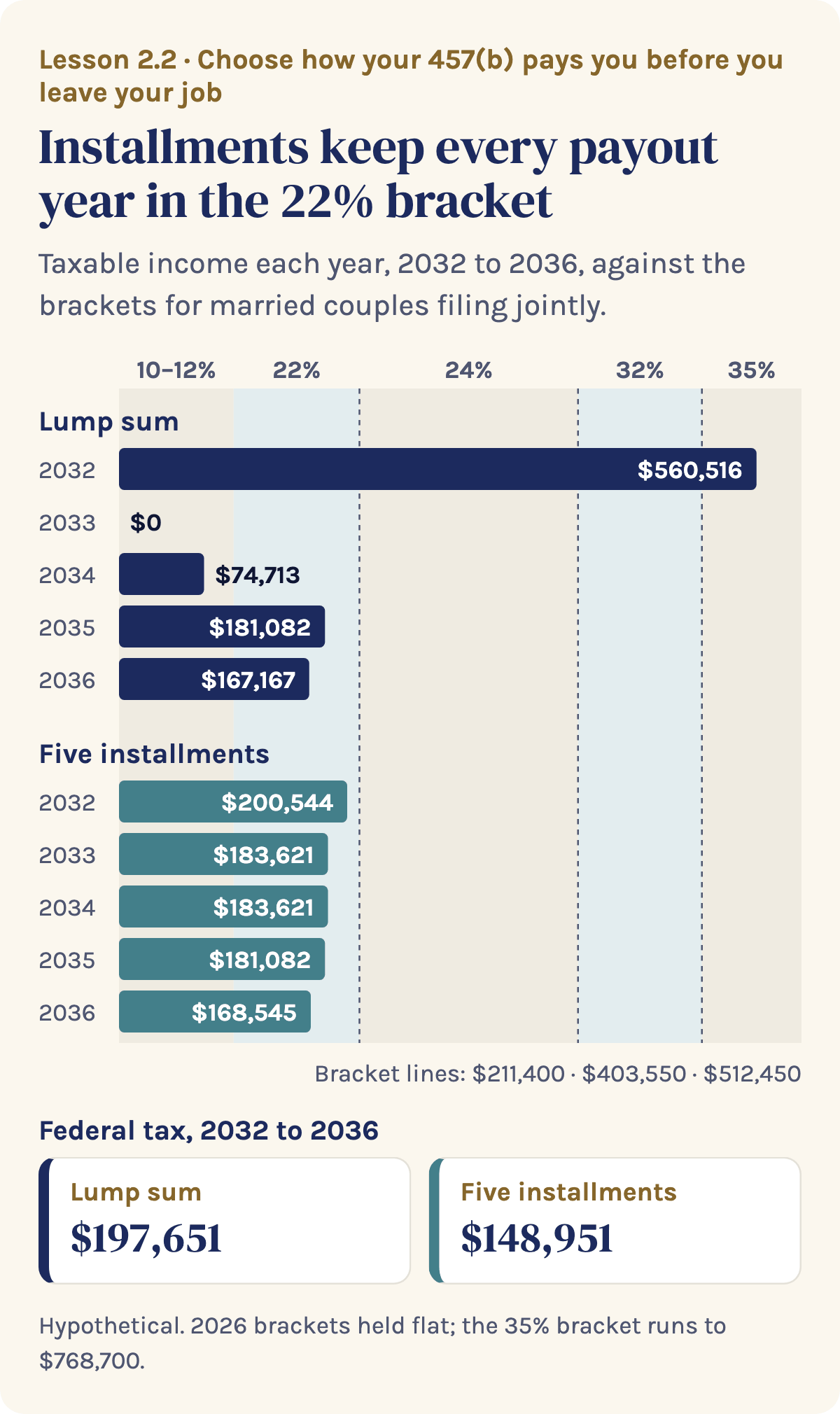
Both columns below pay for the same spending from 2032 to 2036. For a like-for-like comparison, whatever the 457(b) doesn't cover comes from David's 403(b), which is taxable income too; Lesson 3.4 shows a lower-tax order. With the lump sum, the money left after 2032's tax pays for 2033 and part of 2034.
| Lump sum in 2032 | Five installments, 2032 to 2036 | |
|---|---|---|
| Paid from the 457(b) | $593,000 in one year | About $128,000 a year |
| Taxable income in the payout years | About $560,500 in 2032 | About $168,500 to $200,500 a year |
| Top bracket | 35% | 22% every year |
| Federal tax, 2032 to 2036 | About $197,700 | About $149,000 |
A lump sum would also raise their 2034 Medicare premiums by about $12,710 for the two of them, because Medicare sets each year's premium from the tax return two years earlier (Lesson 3.3).
A nonprofit's 457(b) can't be rolled into an IRA or a 403(b), where David could withdraw at his own pace, so the payout schedule is his only way to spread the tax. Texas has no income tax, so only the federal brackets matter; your CPA can work out the tax on each payout option with your numbers.
Until it's paid out, your 457(b) can be claimed by your employer's creditors
David's plan is a non-governmental 457(b), the kind a nonprofit employer offers. By law, the money belongs to the health system until it's paid to David. If the health system is sued or goes bankrupt, its creditors can claim it, and David would wait in line with them to be paid.
On his five-year schedule, the last payment comes in 2036. Before you pick installments, weigh the tax they save against the chance your employer goes bankrupt before your last payment. A shorter schedule leaves less of your money with the employer, for fewer years, but puts more of it in higher tax brackets.
In the next email: why a market drop in your first years of withdrawals does more lasting damage than the same drop later, and the cash reserve that keeps you from selling after one.
Chad
A full lesson from the course. Scroll to read it.