Make Your Money a Routine.
A free email course for Waco families in their 30s and 40s. Set up a paycheck system that saves before you spend, protect your family, and grow what you save.

Start the Course.
Use the email address where you get The Waco Buzz. Your welcome email from Chad arrives in about 5 minutes.
Starting a course also subscribes you to The Waco Buzz, Waco's free local newsletter, if you aren't already. Unsubscribe anytime.

Last email's big point
- Money for goals that are years away needs to be invested, and the earlier it goes in, the longer it has to grow.
Today's key takeaways
- Most people save whatever is left at the end of the month, and very little is ever left.
- Consider having every paycheck land in a savings account first, then moving only your planned spending to checking.
- Build your spending number from twelve months of statements, including the bills that come once a year.
Hi there,
Most of us run the same plan. The paycheck lands in checking, we pay the bills, and whatever is left at the end of the month goes to savings. How much ever lands in savings? Very little.
When families come to see Jessica and me, I'd estimate 95% of what they've saved is in a 401(k), 403(b), or TSP. It didn't get there because money was left over. It got there because it came out automatically, before the paycheck ever landed in checking.
Raises work the same way. If your boss gives you a 3% raise and it lands in checking, your spending grows to absorb it. I've had clients get a big bonus, and when I asked months later what they did with it, the answer was, "I don't know." It landed in the spending account.
Build the system in three steps
- Capture. Every paycheck goes by direct deposit into one high-yield savings account, which I call the Cash Account.
- Deploy. Once or twice a month, move the amount you plan to spend into checking. Checking holds what you intend to spend.
- Build, then assign. Let the Cash Account grow to a target. Every dollar above it gets a job: paying off debt, investing, or a cost you know is coming.
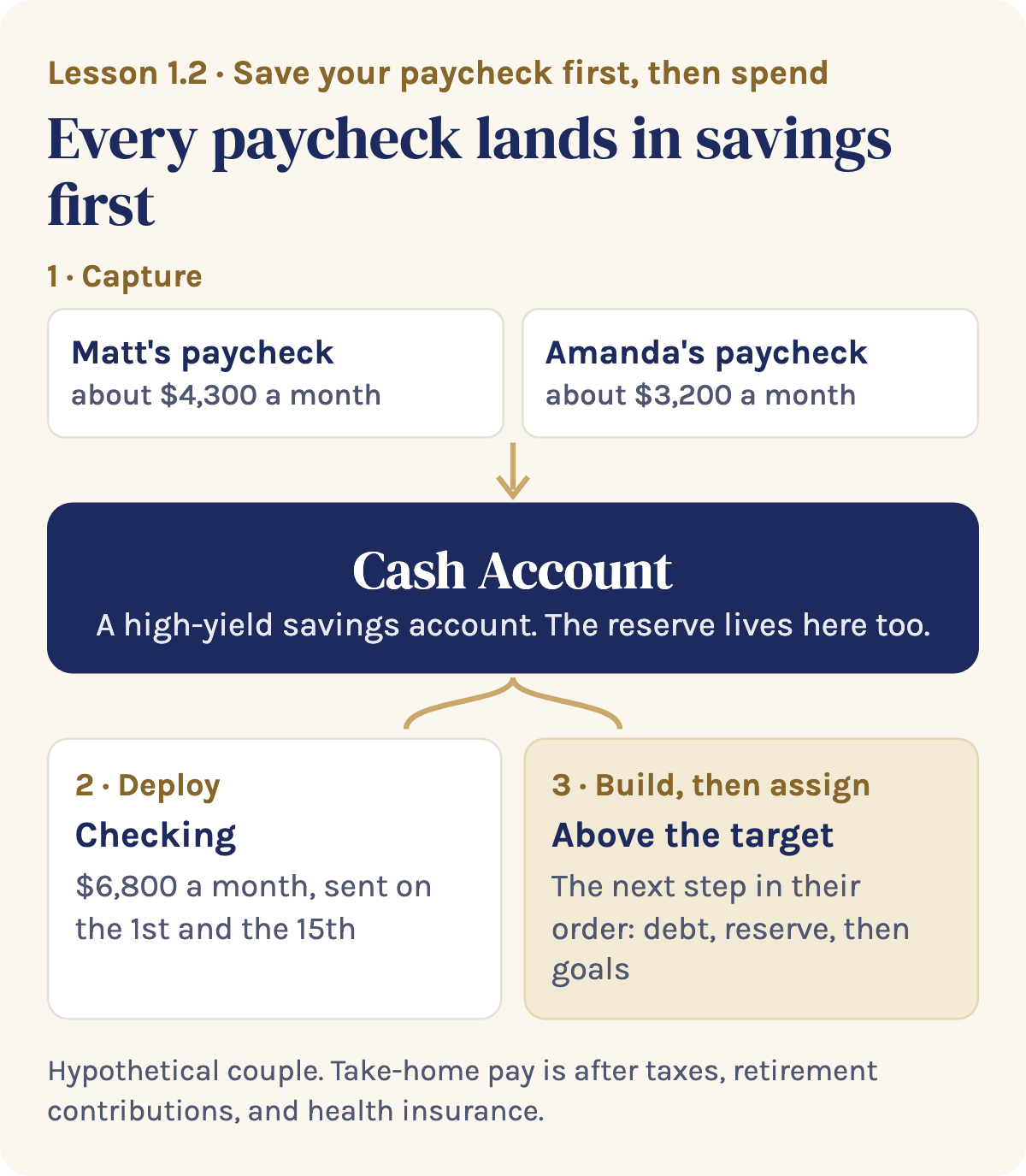
You stop saying, "I hope I can save 5% of whatever's left," and start saying, "I save all of it, and then I decide how much to spend." When my wife and I set up our accounts this way, we had an extra $20,000 in savings seven months later. I'm not saying that to impress you. I'm saying it to frighten you. The only thing that changed was that I disconnected our income from our spending account.
Find your spending number from a year of statements
Matt and Amanda take home about $7,500 a month. They guessed they spend $6,500. When they added up twelve months of bank and credit card statements and divided by twelve, the number came to $7,300. A full year of statements catches the costs that come once a year, like Christmas, back-to-school, and summer camp, which a guess usually misses.
To find yours:
- Leave out transfers between your own accounts.
- Count credit card purchases or credit card payments, not both.
- If a yearly bill came out of an account you didn't pull, add a monthly share of it.
Then send that amount to checking and see how it works. You might find you need to send more, or that less works fine.
In the next email: Matt and Amanda find $700 a month, and we decide what it should do first.
Chad
A full lesson from the course. Scroll to read it.